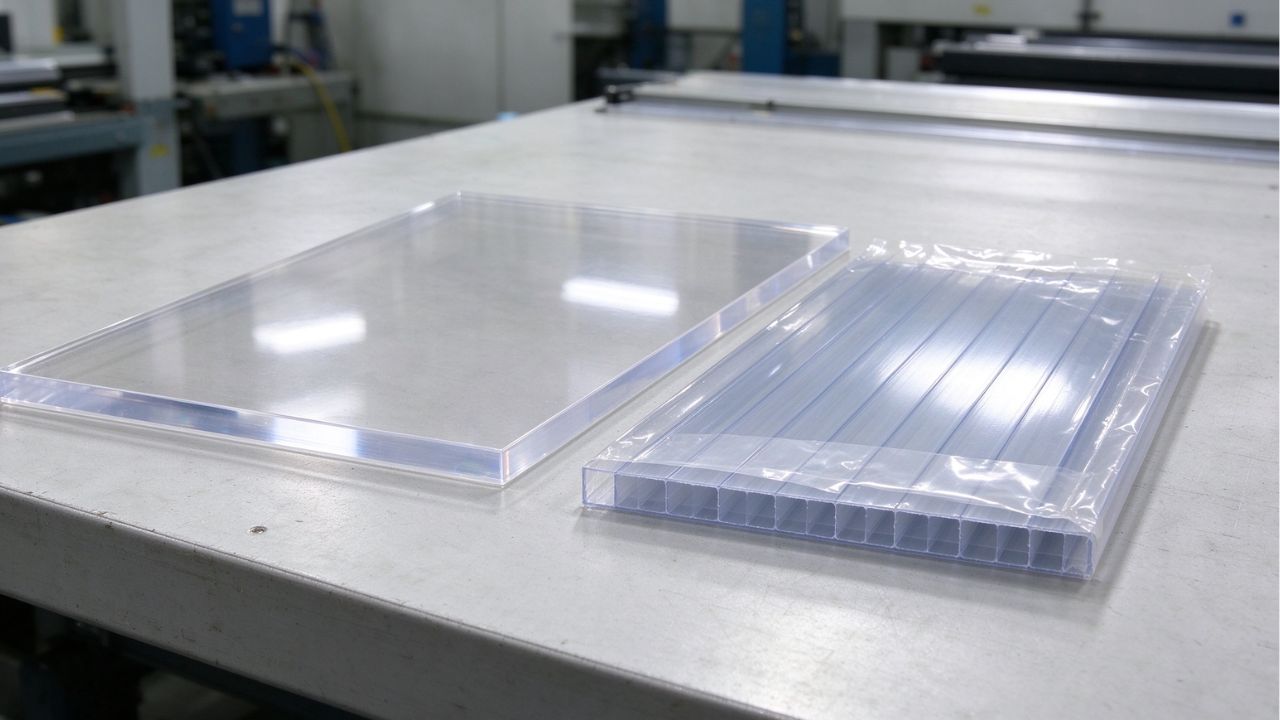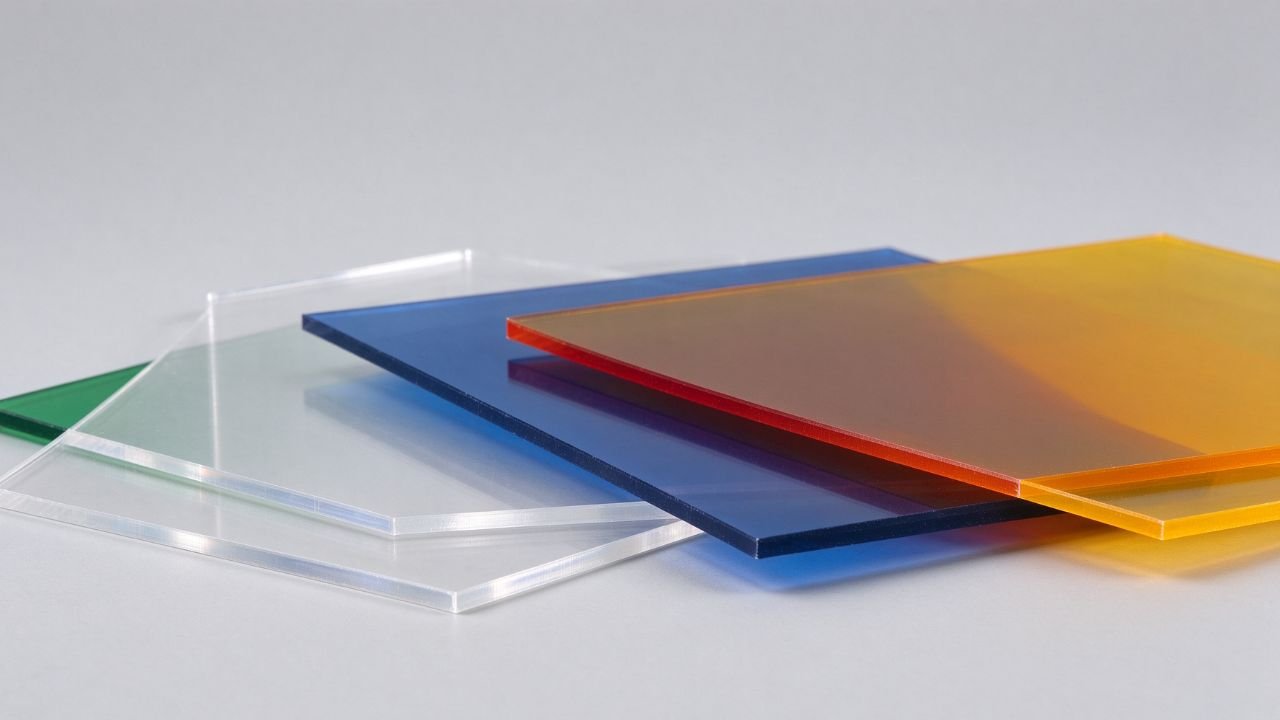
Use the wrong adhesives, and the seams on your polycarbonate plastic sheets will turn white and crack. The entire sheet will be unusable—and you’ll have to deal with customer complaints. Let’s walk through the types of glues that actually work for bonding PC—whatever the material or application, you’ll know which one to grab.
Polycarbonate Adhesive Types
Solvent Cement
Solvent cement bonds by melting the surface of the polycarbonate plastic sheets, and it fuses the seam between the two sheets into a single unit. The strength of this chemical welding is nearly equivalent to that of the base material, and the joint can be made completely transparent. For projects where both transparency and strength matter—display cases, light boxes, and the like—solvent cement is hard to beat.
During the operation, the fumes emitted by solvent cement are toxic. Your workshop must be properly ventilated, and operators must wear protective masks. It’s not suitable for filling gaps. Make sure the contact surfaces of the two boards fit together smoothly and evenly before you apply anything.
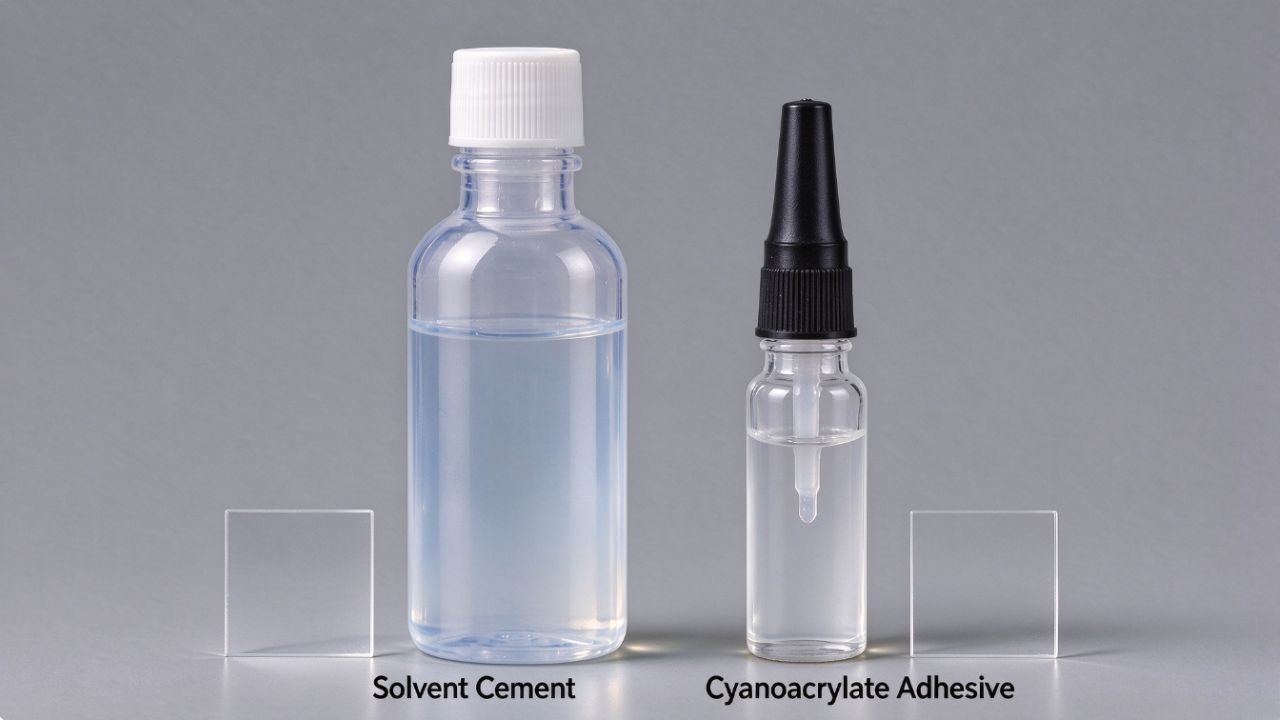
Cyanoacrylate (Super Glue)
Super glue sets in just a few seconds, making it a go-to for small-area repairs and temporary bonding. But its adhesive layer is relatively brittle and not impact-resistant. It may crack when subjected to impact or shear forces. Avoid applying too much cyanoacrylate to the polycarbonate sheet, as it will leave a white, hazy residue around the seam that will greatly affect the appearance.
If your polycarbonate plastic will be submerged in water for an extended period, you should not use super glue. Its adhesive strength decreases in humid environments. In the workshop, most people reach for it to quickly tack down small parts, not as a primary structural adhesive.
Two-Part Epoxy
If you want to bond a PC board to metal or ceramic, you can use two-part epoxy. Once you mix it, it forms a hard adhesive layer that can fill gaps. Get the mixing ratio wrong, or don’t mix it thoroughly enough, and the final bond strength will suffer. Manual glue mixing is prone to creating weak spots. You can use a glue mixing tube instead.
Two-part epoxy has a long curing time, so you’ll need to use jigs and fixtures to help with positioning. Standard single-part epoxy tends to yellow and become brittle when exposed to the outdoors. For industrial settings, stick with a professional-grade two-part epoxy formulation.
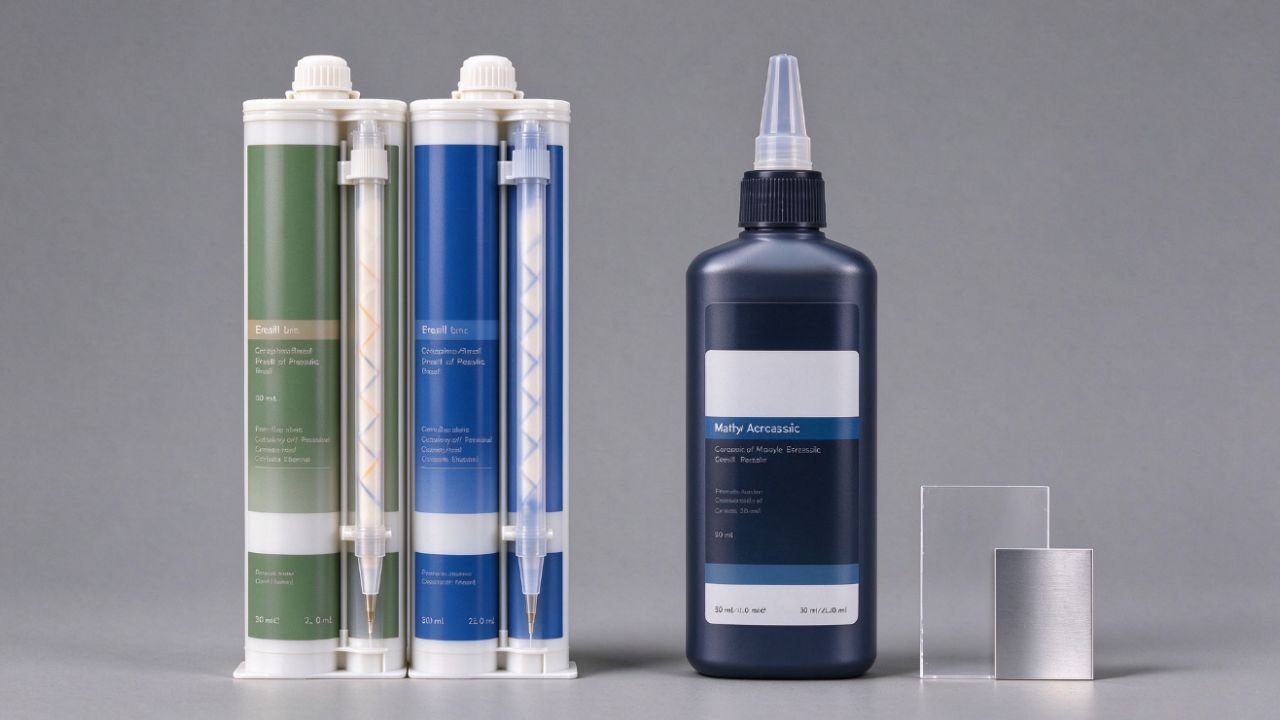
Methyl Methacrylate (MMA)
MMA structural adhesive is both strong and flexible, capable of withstanding vibration and impact loads. That makes it a solid pick for load-bearing components like transportation equipment and machine housings. It has a strong odor, and the volatile gases are highly irritating to the respiratory tract. You must have workers perform this task outdoors or in an area with powerful ventilation.
After curing, the adhesive layer formed by methyl methacrylate retains some elasticity and is not as prone to stress cracking as pure hard adhesives.
UV-Curing Adhesive
UV-curing adhesive cures only when exposed to ultraviolet light. You need to make gradual adjustments in position. Once cured, the UV-curing adhesive is clear enough that the seam practically disappears. That makes it worth considering anywhere the look of the joint matters, like optical screens or transparent display fixtures.
The adhesive bead of the UV-curing adhesive must be directly exposed to the light source. The light source wavelength must be compatible with the glue so that the bonded polycarbonate plastic sheet is transparent and does not feel sticky to the touch.
Polyurethane Adhesive
Polyurethane adhesive is resistant to cold environments or freezer applications. Even at sub-zero temperatures down to -40℃, it stays flexible rather than brittle, and holds up against gasoline, salt spray, and similar chemicals. It is commonly used to bond PC sheets in outdoor signage and cold-chain equipment.
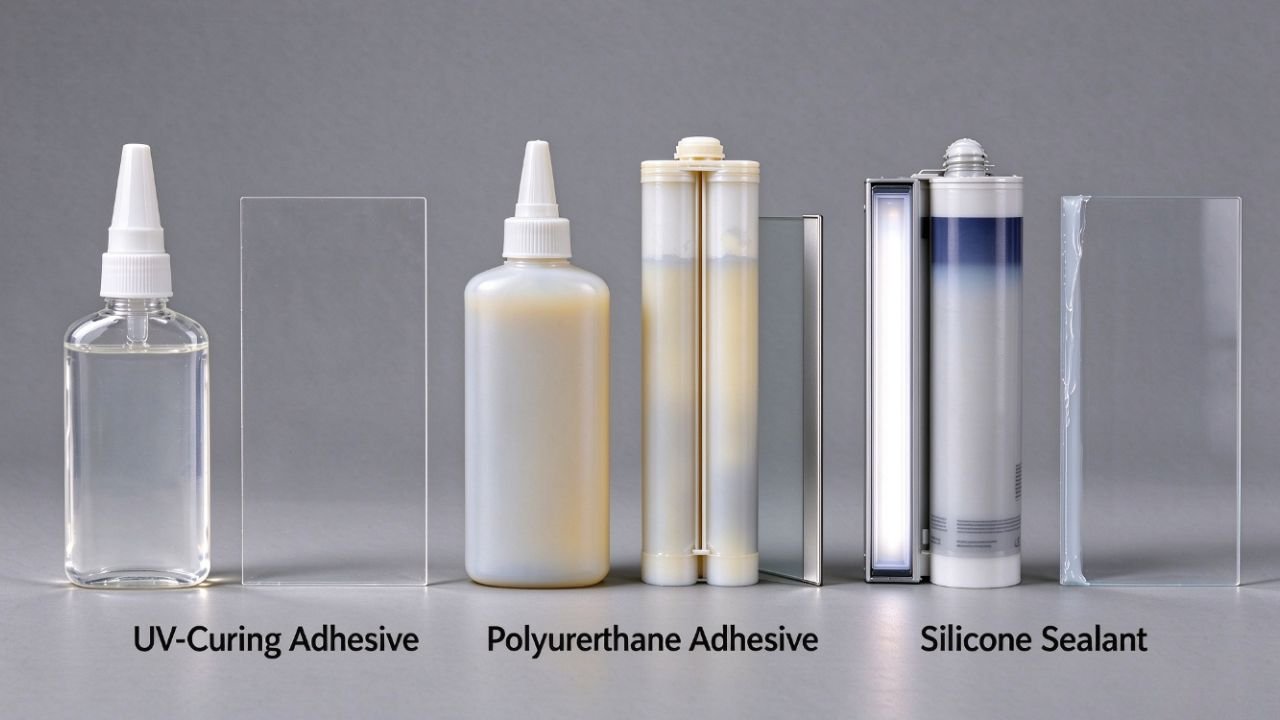
Once cured, polyurethane adhesive is not completely transparent. It tends to have a yellowish or whitish tint, and its strength is not as high as that of MMA or epoxy. It has good elasticity and can absorb some of the vibrations. Because of that combination of high elasticity and lower tensile strength, use polyurethane adhesives for non-load-bearing or dynamic sealing joints.
Silicone Sealant
You can use silicone sealant to create a waterproof seal. The elasticity and weather resistance are both solid. Use it for sealing light box edges or waterproofing seams in outdoor installations.
Silicone sealant has very limited adhesive strength—it can be torn apart with your hands. You should never use it in applications that require load-bearing or structural support. It gives off an acetic odor as it cures. Keep the area ventilated when using it in an enclosed space.
Choosing the Right Polycarbonate Adhesive
| Project Type | Commonly Bonded Sheets/Materials | Base Adhesive | Adhesive Agent |
| Display cases, light boxes, transparent display stands | PC board to PC board | Solvent cement | UV-curing adhesive |
| Machinery and equipment enclosures, transportation components | PC board to metal, PC board to PC board | Methyl methacrylate | Two-part epoxy |
| Outdoor signage, cold chain equipment, chemical processing facilities | PC board to metal frame, PC board to PC board | Polyurethane adhesive | Silicone sealant |
| Minor repairs, temporary positioning | Small PC components, nameplates, plastic parts | Cyanoacrylate | —— |
| Optical screens, transparent display fixtures | PC board to glass, PC board to PC board | UV-curing adhesive | —— |
FAQ
Does the Surface of Polycarbonate Plastic Need to Be Pretreated Before Bonding?
Yes—start by wiping down the bonding surfaces of polycarbonate plastic with isopropyl alcohol or a neutral detergent. If the adhesive instructions explicitly call for sanding, you can quickly and lightly sand the surface once with fine-grit sandpaper (600 grit or higher). Don’t apply too much pressure. Apply immediately after processing. If left for too long, it may collect dust or absorb moisture.
Never wipe a PC board with acetone, MEK, or harsh aromatic solvents. While isopropyl alcohol (IPA) is safe for surface cleaning, avoid soaking the sheet or using industrial-grade denatured alcohols with unverified additives.
What Glues Should I Not Use on Polycarbonate?
Do not use any adhesives or cleaning agents containing acetone, toluene, or chlorinated solvents. Any contact with these substances will cause the PC board surface to turn white and crack. Standard PVC pipe adhesive does not match that of polycarbonate, so you shouldn’t use it either.
Strongly alkaline cleaning agents will gradually erode the surface of the board. You can’t use epoxy repair putty on polycarbonate. It cures too hard and has no give, which means the sheet will crack once stress builds up.
What Is the Best Glue to Repair Cracked Polycarbonate?
If the crack in the polycarbonate is a fine line, you can first use a small drill bit to drill a stop hole at the end of the crack—that keeps it from running any further. Then apply a thin coat of low-viscosity solvent cement to the surface of the crack and let it seep in on its own.
If the crack is fairly wide, you’ll need to fill it with UV-curing adhesive. It is transparent and cures quickly. If the crack is in a stress-bearing area, you’ll need to sand down the cracked polycarbonate thoroughly and fill it with MMA glue to ensure it retains sufficient strength.
How to Glue Polycarbonate to Metal, Wood, Or Other Plastics?
| Substrate Material | Key Points for Surface Treatment | Recommended Adhesives (in Order of Priority) |
| Metals such as aluminum and stainless steel | Sand until smooth, then degrease with isopropyl alcohol. Acetone should only be used on metal surfaces. Avoid contact with PC boards. | Two-part epoxy, MMA |
| Wood | First, apply a primer to seal the pores in the wood, and let it dry before gluing. | Two-part epoxy, polyurethane adhesive |
| Acrylic (PMMA) | Clean and degrease. Do not sand. | Solvent cement, MMA |
| ABS, PVC | Clean and gently sand. | Solvent cement, two-part epoxy |
| Polyethylene (PE), polypropylene (PP) | Flame or corona treatment, or application of a polyolefin primer. Otherwise, it will not adhere. | Two-part epoxy (requires pretreatment) |
What Is the Shelf Life of Two-Part Epoxy for Polycarbonate, And How Should It Be Stored?
Unopened two-part epoxy kept in a cool, dry spot will generally stay good for 12 to 24 months. We recommend that you keep the temperature between 15 and 25°C. Avoid direct sunlight and don’t expose it to moisture.
After use, screw the lids on tightly. Especially on the containers holding the hardener, as moisture can easily cause it to clump and become unusable. After opening, mark the date on the can. Do not use the product after the recommended expiration date. If the resin tank crystallizes in the winter, you can soak it in warm water. Once it returns to its normal state, it will still work fine.
Are There Special Adhesives for Cast Polycarbonate vs. Extruded Polycarbonate Sheets?
Cast polycarbonate sheets have better chemical resistance. You can use them with solvents, cement, and MMA.
Extruded polycarbonate sheets are sensitive to solvents and prone to stress cracking. You should prioritize UV-curing adhesives, two-part epoxy, or polyurethane adhesives. If you only have solvent cement on hand, be sure to test it first on a small, inconspicuous scrap to make sure it doesn’t become cloudy or crack before proceeding with the actual bonding.
You should completely remove the protective film from the surface of the extruded polycarbonate sheets. After peeling off the film, wipe the surface with isopropyl alcohol to remove any dust attracted by static electricity. Apply the sheets once they are clean.
Final Thoughts
Getting a clean, lasting bond comes down to matching the right adhesive to your specific panels and application. We supply polycarbonate sheets in a range of thicknesses and grades, and will help you choose the right adhesive. If you want to run adhesion tests before committing, reach out and we’ll get you some samples.